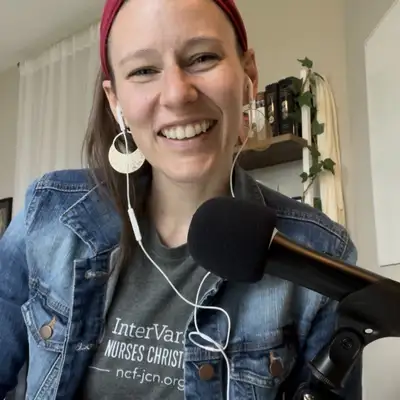
Hey y'all! Welcome back to Following Jesus in Nursing! Today we're kicking off season 4 where we're talking about burnout. Not the buzzword version, but the kind that settles deep in your bones and makes you question your calling, that leaves you feeling so tired you don't even know what you're feeling. Alongside stories of burnout this season, we'll also choose some selections from the Psalms and ask ourselves, What does Scripture say to weary nurses?
Lara:How does God meet us when our compassion runs dry? And is there a way to practice nursing in the face of burnout that's not just skillful but also heartful? To help us introduce and frame this season, I'm joined today by our director, Dr. Kathy Schoonover-Schoffner and later we'll hear briefly from our associate director Jen Wojtysiak, who will explain our method of study for our time in the Psalms together. Listen in.
Kathy:It's a severe state of just this physical, mental, emotional exhaustion. So you feel constantly overworked. You don't want to go to work. You feel like nobody appreciates you. You're not making a difference.
Kathy:It's really tragic in nursing because nursing is a sacred work. We're meant to be promoting health and touching people in the most beautiful as well as most difficult moments of their lives. And if you're burnt out and you're not able to engage with that, what happens to the patient? What happens to you? There's different types of psalms.
Kathy:Some of them are songs or hymns of praise to God. Some are songs of celebration, thanksgiving, being grateful to God. But a lot of the psalms are about lament, crying out for help. David wrote many of his psalms in states of severe distress. The Lord is a refuge for the oppressed, a stronghold in times of trouble. Perfect psalms for feeling burned out, Perfect words for a person who's burned out.
Lara:Welcome back, Kathy. Thank you so much for kicking off this season with me today. It's great to have you back on and love to just have you introduce yourself again for our new listeners and catch us up for the returning listeners on anything that's new with you lately.
Kathy:Well, thank you. It's good to be back. People are loving this podcast, Following Jesus in Nursing. And here we are at season 4, which is like, who would have thought we'd get this far? But God is blessed and I think we're hitting a nerve with nurses, really touching their lives.
Kathy:So my name is Kathy Schoonover-Shoffner. I am the National Director of Nurses Christian Fellowship, and I'm also the editor in chief of our Journal of Christian Nursing. I'm married and have three grandchildren, live in Kansas, and I have a little dog, Stella Chiweeney, that's become a real sweetheart to me. Never wanted a dog, but got a dog for my daughter. What's new with me?
Kathy:I never thought I would do this, but I've been watching The Chosen and really having fun with that. It's about the life of Jesus, and that's what I'm doing to kick back and relax sometimes in the evenings. Still exercising, still working hard, still taking the camper out.
Lara:Still strong doing those bicep curls.
Kathy:I'm still doing the bicep curls. I wish I could show you my deltoids here.
Lara:I see them.
Kathy:My triceps.
Lara:For those who can't see, they're looking strong. Yes. Well, this season, Kathy, we're talking about burnout. So to kick us off, when you hear that word, what comes to your mind? What are we talking about when we're talking about burnout?
Kathy:Well, burnout has been studied a lot and researched in different professions, different areas. It's not a fun thing. It's the state of physical, emotional, and mental exhaustion. It's characterized by three main pillars, this overwhelming exhaustion, cynicism and detachment, and just this reduced sense of accomplishment in your life, in your work. So you don't feel like you're accomplishing anything.
Kathy:Your symptoms are like you're physically exhausted, and that doesn't improve no matter how much you rest. You know, you may have trouble sleeping, headaches, your tummy responds to stress, you don't like to eat or you eat too much, and you're just kind of cynical, sarcastic. I mean, I love sarcasm, but this is just like there's a loss of joy and you're just emotionally detached. And so you procrastinate, you withdraw, you're crabby, just feeling bad.
Lara:Yeah. That sounds like pretty thorough, like, externally, it's in your behavior. It's in your physical and emotional self. It's very thorough. What does burnout look like then in nursing specifically? How do you see it play out?
Kathy:Well, I think nurses can work in this unmanaged workplace stress and life stress. And so I think it's a severe state of just this physical, mental, emotional exhaustion. So you feel constantly overworked. You don't want to go to work. You feel like nobody appreciates you.
Kathy:You're not making a difference. I mean, I think you have the same symptoms, but unfortunately it's really tragic in nursing because nursing is a sacred work. We're meant to be promoting health and touching people in the most beautiful as well as most difficult moments of their lives. And if you're burnt out and you're not able to engage with that, what happens to the patient? What happens to you?
Kathy:You have this compassion fatigue, this emotional numbness and reduced empathy, and you just don't feel good. You might make a higher rate of medical errors. They found that in the research, you're just not interacting well with your peers, your co workers. You know, I just think of burned out like a fire when you're camping or something and you throw a piece of paper or trash on the fire and it was full and white and okay. And then all of a sudden, it's kind of shriveled up and crispy and black. It's changed. It's burned out.
Lara:How common do you think burnout is in nursing?
Kathy:Well, that's interesting. In 2020, the American Nurses Association did a survey and they found almost two-thirds of nurses, like 62%, were experiencing burnout. They asked them questions. They didn't say, Are you experiencing burnout? The nurse thought and said, Yeah, I think I am.
Kathy:No, they asked them about the symptoms and the experiences of burnout, and they concluded that 62% were experiencing burnout. But what was even sadder was that the younger nurses, (69% percent of nurses) reported burnout, so we're talking about new grads who've only been in nursing a year or two, and it was across hospitals, across any kind of healthcare systems in the US. So that's a pretty high rate of burnout in nursing, two-thirds.
Lara:Well, and it's interesting the way that survey was done. We're not necessarily relying on people's self awareness to indicate whether people are burned out or not. And I think it's revealing it's more nurses are experiencing burnout than not. That's a lot.
Kathy:Well, that was 6 years ago, in 2020. I don't know, was that in the middle of COVID or not? I'm not sure.
Lara:COVID started in March. So I guess it depends on when the survey was and how impacted people were feeling at that point.
Kathy:Well, that could be an intervening variable. But I suspect that those statistics aren't, if they're different, they're not a lot lower. I mean, I still think a significant number of nurses and new grads are burned out.
Lara:Well, what I'm thinking of is whoever's listening to this episode is either experiencing burnout presently, has experienced burnout, or is working alongside people who are experiencing burnout. So it's very
Lara:relevant. So I wanna go back to something you're talking about earlier, that one of the symptoms is this physical manifestation of fatigue. One question that I always wrestle with is what is the difference between burnout and just being really tired? Like how do you know if you're burnt out versus just needing a lot of naps?
Kathy:Well, I think if you take your days off, or if you request some PTO, paid time off, or you take a vacation and you get some sleep, or maybe you have grandma and grandpa take the baby and you get some extra rest, or take a day to just relax and you feel better, then maybe you were just tired. Yeah, you needed to sleep in or take an extra mommy nap or something. But being burned out, the fatigue doesn't go away, the numbness, the irritability, the frustration, the compassion fatigue, you know, you just don't care. You don't want to go to work and you took some days off and you go back and you're like, I don't want to go back to work.
Lara:So addressing the physical fatigue, seeing what does or doesn't resolve and seeing if there's still some underlying, like apathy and numbness.
Kathy:Yeah. And if when you take a break, and you do things that normally would rejuvenate you and you're not getting renewed, maybe consider burnout.
Lara:Though if rest can resolve fatigue or exhaustion, just sort of normal tiredness, then I think my natural question that follows is what's the antidote then for burnout? If it's not just sleep? What what brings resolution to burnout?
Kathy:What's interesting is I was just looking through what's recommended and a lot is said about preventing burnout.
Lara:So don't even get there in the first place.
Kathy:Don't get burned out. Yeah. And so, obviously, resting and taking recreation and relaxation, eating well, eating healthy, exercising, taking care of your body. I think when you're burnt out, you need to up the ante on those. You need to maybe take a longer break.
Kathy:I think a difference too is asking for help, you know, saying, this isn't working for me, the mental load, the physical load, the spiritual load, you know. Maybe talking with co workers or a supervisor where you could vent, consider contacting a therapist, or talking to a pastor or a spiritual director, spiritual counselor, not just trying to figure this out on your own, this emotional, mental, spiritual support. I'm a firm believer in exercise and those endorphins and all that. I think when you're burnt out, the last thing you want to do is go exercise, but you know, go for a walk, take your dog for a walk, take your significant other or friend. You know, I'm a member of the YMCA, just going and doing physical exercise and even something strenuous where you really get cardio and stuff can help. The difference is getting the emotional support and maybe you need a prolonged break. I was just looking at some research that says that 55% of Americans don't use their paid vacation time.
Kathy:If you have paid vacation time, you have time off, take it. I'm bad about that. I need to just step away from work, separate myself. So I think something that's helpful, not only in preventing burnout, but when you're burnt out, is you've got to take a break. You need to disconnect from work or from whatever it is you're burnt out about.
Kathy:So you've got to unwind and relax and do things to recharge your physical and emotional reserves. I think nurses especially, have a hard time taking off because we know how low staffing can be. You know, they're going to need my help and they'll even call me and say, Can you come in? Unfortunately, don't be that. Just say, To be my best self, I need time off. So don't feel guilty for leaving your work and leaving your patients behind, because you need to avoid burnout so that you can take better care of them.
Kathy:I think another thing that's newer in today's environment is you can request training or hospitals have things that will help you better cope with the demands of the job. Most workplaces do, and so talking to a supervisor or a safe person saying, Hey, what can we do to decrease the stress around here? You know, is there some training or what can we do to to take a break? Doing something fun together at work. Yeah.
Kathy:Bringing in pizza. I don't know.
Lara:Yeah. Now we're thinking pizza parties and fun. Just something that occurred to me while you're talking. I think in systems, sometimes it's hard to ask for help. But when a system is stuck, there's nothing within that system that can be used to get out of that stuckness.
Lara:We need something introduced to the system from outside of it. It's kind of an old, tired analogy, but if you run out of gas in your car, you can't go get gas because you don't have any gas to get to the gas station. If we wait until the system is completely depleted of resources, the the system stops functioning. So I'm just thinking of if our own internal selves are a system. It's good and okay to ask for help because if we're finding ourselves at that position where we have nothing left within us, then we get stuck. We need something from outside to get unstuck.
Kathy:Yeah. Makes me realize I just had an experience today. I had to take my car in to get work on it, and we only have one vehicle, and my husband's not here, and he can't drive with his brain injury. And so I knew that I needed to get home and I was trying to figure out what to do sitting here in the car place and I was going to walk home. And in walks this friend, another nurse actually, that I hadn't seen in years.
Kathy:And we were talking and I said, Hey, I'm here and blah, blah, blah. And she says, Well, why don't I give you a ride home? And then she even said, If you need a ride back here, call me and I'll come back and get you and take you back. I mean, I realized I'm just thinking in our burnout, in our weariness, in our frustrations of life, in the difficulties of life, Watch for Jesus. H just showed up and provided this friend to give me what I needed in that moment, and it was a simple thing.
Kathy:Spending time with Jesus, for sure, Bible study, prayer, quiet times with him to recuperate, but looking for him to bring a cup of cold water or the food that you need, the space, the help that you need.
Lara:So why do we think nurses are especially vulnerable to burnout? This is one of a handful of professions that I hear the word burnout the most around. So why do you think nurses in particular are vulnerable to burnout?
Kathy:Well, I think part of it is just the intensity of the acuity of what we do, frequent exposure to patient and family suffering and trauma and death. So you're exposed to intense things. I think just the high nurse-to-patient ratio. So we're being asked to stretch ourselves sometimes beyond safety capacity. So staffing shortages, as well as the high acuity and the trauma.
Kathy:I think nurses feel little control over things sometimes. So this lack of autonomy, like if I can't control my life and it's just happening to me, there's this sense of I'm hopeless, helpless, there's nothing I can do. That isn't the answer, just say, well, that's it. There are other ways to look at building autonomy, but when people lack of autonomy, they get burned out. And then I think just also, we're taking care of the computer, the electronic health record, we're, you know, cover your bases, documentation and regulation and all the things you have to do to make sure that everything's going to be okay and what could be said if anything happens.
Kathy:You do a lot of over-documentation. You know, the patient was in the room, they were safe, you asked questions, they answered, you did put the rails up, you know, or whatever. So you end up with just this really intense, you got to cover everything. And so the tendency to get overwhelmed is easy in nursing.
Lara:Yeah, that captures it really well. So earlier, you had mentioned that sometimes nurses can hit burnout pretty early on in the career, like within the first couple of years. That really surprised me. I can understand how someone would experience burnout after a decade or two. But after a month or two, just that's a lot.
Lara:That is it's kind of heartbreaking that it hits so fast. So I'm just curious, how does that happen? You know, if nurses in general are maybe more vulnerable to burnout, what makes young nurses even more vulnerable?
Kathy:Well, it's probably generational differences like my generation, the boomers, you know, optimistic, glasses half full and filling, very altruistic. And I think generations now don't have that same built in, you know, you just keep working until you fall over mentality. And so it's just easier, you know, the ANA study that 67% of nurses age 25 were burned out. And so that means they've only been out of school, you know, at the most five years, but more than likely two or three. You know, I'm not sure; I think it's maybe it wasn't what you expected it to be.
Kathy:You'd thought you went into nursing to help people and all you're doing is running around like a crazy person and you've got too many patients and there's nothing you can do or you feel there's nothing you can do. And what you anticipated, what you'd hope nursing would be is not what nursing is. I think that can lead to huge disappointment. And so younger nurses start to feel like, oh, this isn't what I signed up for. This isn't what I anticipated.
Lara:Yeah, definitely. We're going to hear a couple of stories from nurses later this season about that very thing. This season, we're also throwing out the phrase here, "heartful nursing" as in heart, full of heart. What does that mean, heartful nursing? How are we using that term? Why are we bringing it up around burnout?
Kathy:I think, again, as I said before, nursing is too sacred of a work, it's too special, it's too important for you and for the patients and families. And so if we're not engaged in our work, fully engaged, and it's filling our heart and we're offering our presence fully, then that's heartful nursing. Showing up and showing up with grace and presence. I think of heartful versus heartless, or not being calloused. When you work with someone who's calloused, it's very sad.
Kathy:It's sad for them, as I said, it's sad for the patient. I think, feeling directionless. If Jesus has called us into nursing, and I pray, and I'm spending time with him, and I go in that day and I say, "God, give me the work and the patients you want me to see," and I have a sense of direction of serving them. What are their needs? What can I teach them today?
Kathy:Nursing is about health promotion, health maintenance, health restoration, and so I feel a sense of direction in what I'm doing, because I'm working with the patient towards health. I know that sounds real theoretical and removed, but when you're at the bedside, that's what we're about, is trying to restore their health. So what are we doing for them physically, emotionally, spiritually? And if your heart is not in that, I think you're burned out and directionless, and that's unfortunate for both you and the patient. So I think heartfelt nursing is this emotionally sincere, present, doing what you know nursing is supposed to be.
Lara:Yeah, the whole sense of it, not just hollow going through the motions.
Kathy:And just a quick comment, I think Jesus was the perfect nurse, you know, like, had supernatural insight, and we can get supernatural insight from God. But this connection with Jesus, with the one who knows all things, who knows our hearts, who knows every fiber of our being, every hair on our head, connecting with Him, and being in that moment, what He wants us to be with that person is heartful nursing as well. That happens when you're spending time with God, you're in the Word of God, studying, reading, praying, and fellowship with other believers. So you're in this walking, active relationship with Jesus Christ.
Lara:Speaking of being in the Word and prayer, we have decided to look at selections from the Psalms this season alongside these stories of coming out of burnout. So why are we studying the Psalms as opposed to maybe like a leadership book or resilience strategies? In other words, like what do the psalms uniquely have to offer here as we're talking about burnout?
Kathy:Well, you have to love the Psalms. We've all know the 23rd Psalm, the Psalm of David, the Lord is my shepherd. I will not be afraid. That's kind of a great salm about if you're burned out, don't pray Psalm 23. There's 150 psalms, and there's different types of psalms.
Kathy:Some of them are songs or hymns of praise to God. Some are songs of celebration. Yay, God's with us, we won. Thanksgiving, being grateful to God or grateful for things in life, but a lot of the psalms are about lament, crying out for help. David wrote many of his psalms in states of severe distress, as well as times of great delight.
Kathy:And so I feel like there's a psalm for everything. When I think about being burned out, I think about Psalm 12. How long, oh Lord, will you forget me? How long will you hide your face from me? Just crying out to God.
Kathy:A lot of these lament psalms end with, The Lord heard my cry. He came to me. He delivered me. So you're not just stuck, left with, I was stuck and I'm still stuck, but you can rejoice with David and say, The Lord reigns forever, and he's established his throne. He will judge the world in righteousness.
Kathy:The Lord is a refuge for the oppressed, a stronghold in times of trouble. Perfect psalms for feeling burned out. Perfect words for a person who's burned out. Going back and praising him with all your heart. Psalm p says, I will tell of your wonders. Just affirming who God is and what he does.
Kathy:And so I think the Psalms are wonderful. Like I said, there's a psalm for everything.
Lara:Absolutely. I love that the Psalms don't shy away from the hard stuff and, in fact, kind of leans into it. And so the names gives language to the experience of lament and doesn't try to fix it or resolve it, but just brings it to the Lord and allows the Holy Spirit's healing balm. I think you had said, in a conversation before we started recording, Kathy, about how the Holy Spirit kind of brings us healing balm through Scripture.
Kathy:Yes.
Lara:So we've been talking about the concepts and the statistics. Let's make this personal now. Where have you personally seen the impact of nursing burnout? Why does this matter to you? And what makes you passionate about helping nurses be heartful in their nursing in the face of burnout?
Kathy:Well, I've thought about it, and I don't know that I've personally been burned out or experienced burnout. I've been tired. But I've worked alongside others who are burned out and just observing the strain on the system, how hard it is for patients. I remember working with a nurse who was really in a bad place and a difficult place. And this was in behavioral health, where it's kind of an open milieu on the unit and patients are in, you know, they're not in their rooms and they're all walking around and none of the patients wanted that nurse.
Kathy:And for a patient coming up who had this nurse saying, Can you be my nurse? Can I switch? You know, just because it felt hopeless for them or the nurse was mean. And I said, 'Well, what do you need?' And I think they wanted some cheese and crackers or something, I don't remember, but I couldn't give their meds, but you know, just talking to them and trying to be there for them.
Kathy:So I think it's uncomfortable for the patients. It's uncomfortable for the nurse. I think it spreads, it's a little bit contagious, then we start gossiping and complaining. And again, nursing is too sacred for that. It's not just a job and a paycheck, it's critical for people and for lives.
Kathy:I think also burnout scares younger nurses. I was at Urbana at 2025. It's a student conference InterVarsity does every three years, and there are nursing students there. And we had a meeting for healthcare related students, and there were nursing students in my group. The student said to me, "I don't want to get in there and get calloused and get burned out. I don't want to give up. I'm excited about what God's called me to do. How can I avoid burnout?" And it hit me like, Oh man, you're like in your second semester of nursing school, and you're already worried about this compassion fatigue, this physical exhaustion. And that's appropriate to be aware of that.
Kathy:But I thought to feel like, Oh my gosh, this is a horrible thing to fear. What I told that student is, you gotta stick with Jesus. You gotta, that has to be the constant lifeline, like a baby in the womb with the umbilical cord, or, you know, Jesus said, "Abide in me," and you know, we need to abide in the vine, and that will sustain us. Then doing the things to prevent burnout, the rest and the recreation and the exercise and the eating well and getting enough sleep and, you know, learning to say no, putting boundaries in your life. I think it's possible to avoid burnout and to be fully engaged.
Kathy:Sticking with Jesus and sticking with the Holy Spirit in your life is a crucial thing, and then just hearing his directions. And when you need to take time off, it's okay. Take time off. Take time away.
Lara:Yeah. And I think one thing you had said earlier was we don't want to create more fear or shame or anything like that for people. But we are just saying that burnout can have a ripple effect. Like you said, can spread or be contagious. And it impacts more than just the person who's feeling burnt out.
Lara:And so the invitation to bring heart and heartfulness back into that space is, I think, what we're getting at for the good of everyone involved, the nurse who might be experiencing burnout. So as we wrap up, Kathy, what do you want us to take away from this? And what are your hopes for listeners throughout this season?
Kathy:Well, I hope that this season encourages students, nurses, educators to bring yourself to Jesus. Experience his presence, experience his comfort, his energizing love. As I thought about this, Jesus is the opposite of burnout. He's always full of energy and compassion and grace. He's never tired of us.
Kathy:He's never like, go away or I'm I don't care. He's never apathetic. So bringing ourselves to this Jesus and fully experiencing his presence. And then I also want people to understand, what do you need for yourself and your nursing practice? Or what do you need in this season?
Kathy:Recognize if you're experiencing burnout at any level, starting to experience burnout, feeling discouraged and grumpy or I don't know. Receive support, receive grace, get suggestions for where to go, what to do. I'm a kind of person that I have high energy, and I can do anything, and I don't want to admit that I'm struggling and I need help. But maybe through the stories of burnout, you know, I need help. I need grace. I need to get some help. I need to back off. So fully engaging with Jesus and then recognizing your own burnout or what you can do to prevent burnout and what leads to it. Maybe learning, deciding that you need to prioritize your rest or prioritize some boundary setting. You know, how can you rebuild your personal reserves? Where do you need to seek support?
Lara:That's great. Thank you so much. As we finish up, I would just love if you wouldn't mind offering a prayer for those who are experiencing burnout in this season.
Kathy:Jesus, I thank you that you are the one who said, "Come to me all who labor and are heavy laden, and I will give you rest." I feel like translated, come to me all who are burned out, are compassion fatigued, who are exhausted, who don't care anymore. Come to me. I have the answer for you.
Kathy:I love you and I want to heal you. I will never not care for you. I will always give you rest. So I pray, oh Jesus, will you draw us to yourself? Would you come, Holy Spirit and speak to us and encourage us and renew us?
Kathy:Not just so we can be busy bees for Jesus, but so that we can be in that restful, healthy, flourishing state. I think about flowers, blooming roses, a field blowing in the wind that's so healthy and fresh that we can be nourished and flourishing. We love you, Lord, and we thank you that you're the answer to not only that we need salvation, but you're the answer to burnout and the answer to a happy, productive, fulfilled life. In Jesus' name, Amen.
Lara:Amen. Before we wrap up our episode today, here's a quick word from our Associate Director, Wojtysiak, who will share a brief framework for our time in the Psalms this season.
Jen:Hey, everyone. Jen here. This season, we'll be using a simple inductive Bible study method. That just means we start with the text itself and let Scripture speak before we jump to conclusions. We often come to Scripture with glasses on. It could be our family, our church, our ethnic background. And with inductive Bible study, we seek to remove those glasses and start with Scripture. Each episode this season, our podcasters will be walking us through the three movements or three parts of inductive Bible study method. Number one is observation. What do you notice in the text?
Jen:What are the repeated words, imagery, contrasts, tone, emotion? Answering the who, what, where, when questions. We slow down. We take our time. We want to see what is there and what isn't in the text.
Jen:Part two is interpretation. There we ask the question, what does it mean? What does it mean to the original audience? What does this teach us about God? What does this reveal about human experience?
Jen:If you can ask good questions, you can interpret the text in a way that highlights what the author intended us to hear through the spirit of God. The last part is application. What does this mean for us? What does this mean for us as nurses? What does this mean for us as nurses in 2026?
Jen:How might it shape how we show up at work? How might it change how we pray? What invitation is God extending? What encouragement, what challenge is he giving to us? Inductive Bible study is simple.
Jen:It's slowing down with Scripture, but often it's what our burned out hearts need most. We hope that you will be so encouraged, so blessed by our podcast season, where each of the guests walks us through these movements of inductive Bible study, sharing their heart and Scripture with us in a way that draws us closer to Jesus.
Lara:As we begin this season, maybe you already know that you're burned out. Maybe as you were listening to Kathy today, you're noticing some things that ring true for you. Increased feelings of irritation or fatigue, less patience or hope than usual, or just feeling like you're growing numb or not feeling like your usual self. Or perhaps you're thinking of friends or colleagues who are facing burnout whom you'd like to come alongside.
Lara:I just want to say this season is not about fixing. It is about meeting God in our weariness. I'm excited to do that with you this season. I'm also really looking forward to applying the OIA method from Jen to our study of the Psalms. And the Psalms remind us we can cry out to God, we can tell our story, we can give thanks, and we can look to God for hope and rescue. Let's pray.
Lara:Lord, you see the nurses who are tired beyond words. You see the compassion that feels thin. You see the tears shed in supply closets and on the drive home. Teach us to cry out to you. Restore heartful nursing in us.
Lara:Anchor us in your steadfast love. And as we walk through the Psalms this season, meet us there. Amen.